

Kazakhstan Accelerates Digital Transformation To Attract Global Investment

Kazakhstan is entering a new phase of economic development, combining investment reforms, artificial intelligence, digital infrastructure and strategic industries to strengthen its position as a leading destination for international capital in Central Asia. Addressing the 38th plenary session of the Foreign Investors’ Council, President Kassym-Jomart Tokayev outlined the country’s vision for a more diversified, technology-driven and competitive economy. He emphasized the importance of attracting foreign investment while modernising key sectors including transport, agriculture, energy and mining. Artificial intelligence and digitalisation are becoming central to Kazakhstan’s development strategy, with applications expanding across public administration, education, logistics, industry and investment services. The country is also developing advanced digital infrastructure, including data centres and high-performance computing facilities, while introducing new regulations for emerging technologies. Kazakhstan is further prioritising critical minerals, smart agriculture and the Trans-Caspian transport corridor. These initiatives aim to combine the country’s natural resources and strategic location with technological innovation, creating new investment opportunities and supporting sustainable long-term economic growth.
Strengthening Kazakhstan’s Investment Climate
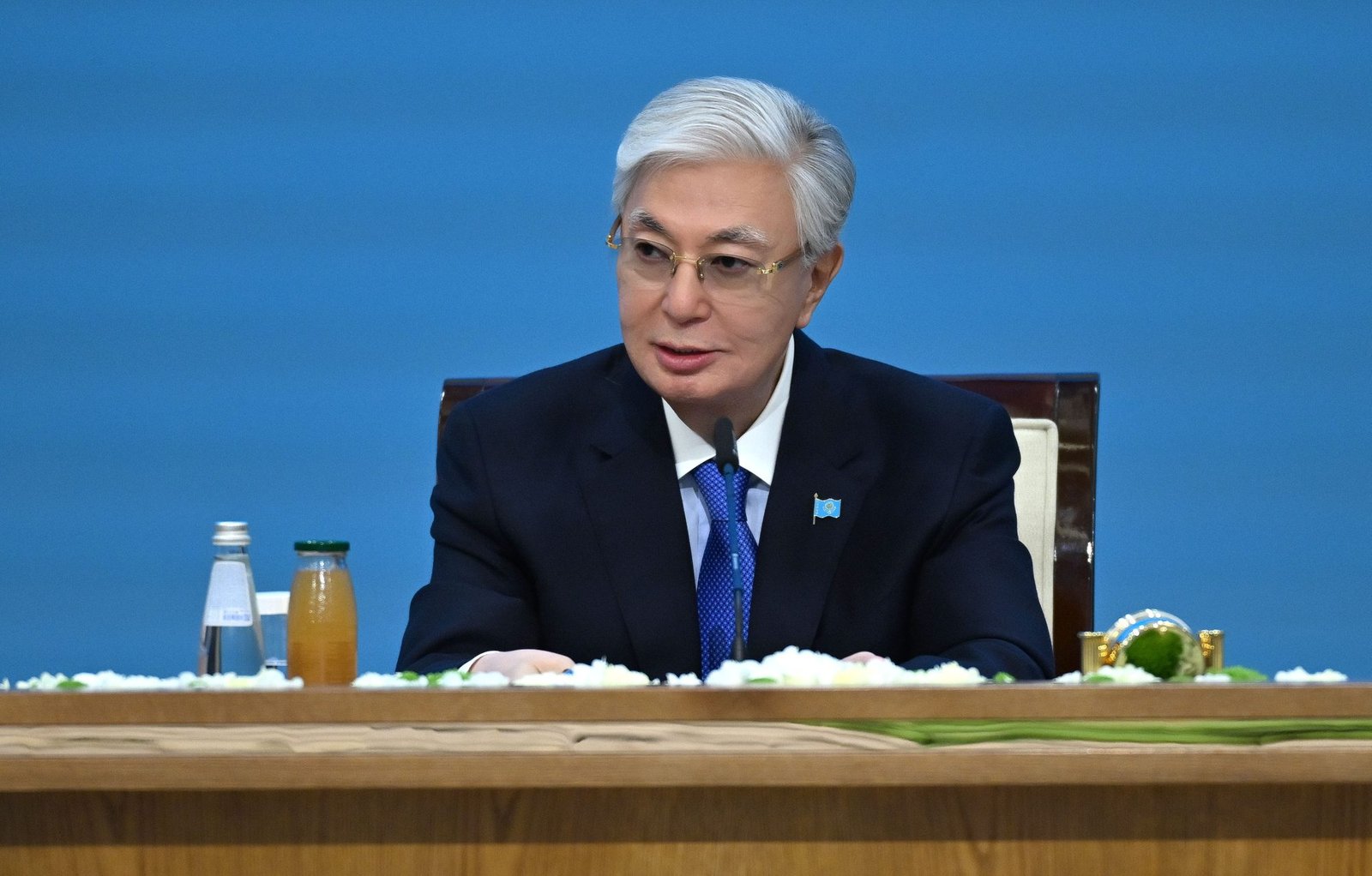

Kazakhstan continues to regard foreign direct investment as an important driver of economic growth and diversification. President Tokayev highlighted the country’s expanding economy, noting that GDP had surpassed $300 billion and that Kazakhstan had accumulated more than $150 billion in net foreign direct investment. The country accounts for a substantial share of investment attracted to Central Asia, reinforcing its position as the region’s leading destination for international capital. The government is also working to make investment procedures more efficient. A National Digital Investment Platform is being developed according to a one-stop-shop model, bringing together services and support for investors through a unified digital environment. The Investment Board is intended to facilitate faster decision-making and coordination between investors and government institutions. Kazakhstan is also using incentives such as the Altyn Visa programme to make the country more attractive to international entrepreneurs. The broader objective is to combine regulatory stability with practical advantages for investors, particularly those interested in establishing long-term operations.

Artificial Intelligence at the Centre of Economic Strategy
Artificial intelligence has emerged as one of the central pillars of Kazakhstan’s economic transformation. The government is integrating AI into investment promotion, public administration, education, industry and other areas of the economy. President Tokayev has described the transformation into a fully digital state as a strategic priority, supported by new institutional and legislative mechanisms. The country has established the Ministry of Artificial Intelligence and Digital Development and created the AI Development Council. Kazakhstan is also developing a regulatory framework covering artificial intelligence, digital technologies and data-driven economic activity. The country’s digital strategy is being supported by advanced computing infrastructure. Two supercomputers have been launched, while plans for a Data Center Valley are intended to establish a major platform for AI, cloud computing and digital services. The project is designed to attract technology companies and international capital and form part of Kazakhstan’s emerging digital economy.

Building a National AI Ecosystem
Kazakhstan’s AI ambitions extend beyond infrastructure. The government is investing in education, research and professional development to create a domestic pool of technology specialists. The Alem.ai International Center has become an important platform for research, education and startup development. Initiatives including Tumo and Tomorrow School are designed to provide new-generation learning opportunities, while advanced laboratories are being developed with international technology partners. AI is also being incorporated into secondary education. The government’s approach emphasizes using artificial intelligence as a tool to support teachers, personalize learning and improve educational outcomes rather than replace educators. Pilot programmes are intended to help reduce differences in educational quality between urban and rural areas.




Kazakhstan is additionally establishing a specialized AI university, aimed at becoming a centre for advanced research, innovation and the training of highly skilled professionals. Training programmes for government officials are expected to accelerate the adoption of AI in public administration. The development of an international AI ecosystem is also attracting private-sector participation. A trilateral memorandum involving the Ministry of Artificial Intelligence and Digital Development, Citi and Freedom Holding Corp. is aimed at developing a large-scale AI cluster in Kazakhstan.
Digital Infrastructure & Data Centres
The development of large-scale digital infrastructure is becoming an increasingly important component of Kazakhstan’s investment strategy. Data Center Valley is envisioned as a strategic platform for AI, cloud technologies and high-performance computing. The project in Ekibastuz is planned across a large dedicated area with access to power, telecommunications and other infrastructure. Its investment framework is designed to support hyperscale data-centre development and attract major technology companies. Kazakhstan is also pursuing partnerships to develop sovereign cloud and AI infrastructure. These initiatives are intended to strengthen domestic computing capacity while positioning the country as a potential digital hub connecting Central Asia and wider Eurasian markets.
Smart Technology for Industry & Finance

Digital transformation is also reaching traditional industries. Kazakhstan is developing digital twins for oil and gas facilities and introducing end-to-end traceability systems for petroleum products. AI-based tools are being applied to predict equipment failures, improve reliability and optimize production. The Astana International Financial Centre provides another platform for testing financial technologies. Its regulatory sandbox allows innovative fintech and AI solutions to be developed within a framework supported by English law and established data-protection principles. This combination of technology, regulation and financial infrastructure is intended to create an environment where international companies can test and scale new digital solutions.

Critical Minerals & Geological Data
Critical raw materials represent another major investment opportunity identified by the President. As global demand for rare earth elements and other strategic minerals increases, Kazakhstan is seeking to modernize the way its mineral resources are managed and promoted. The Unified Subsoil Use Platform has automated 22 state services related to licensing and compliance. More than 4.7 million historical geological records have also been digitized, creating a centralized repository that can be searched and analyzed using modern technologies. AI is being used to convert historical geological information into machine-readable formats. A proposed Regional Research Center for Rare Earth Metals in Astana is expected to further improve access to geological data and support cooperation between international investors, researchers and Kazakhstan’s mining sector.
Kazakhstan as a Eurasian Logistics Hub
Transport remains another cornerstone of the country’s long-term economic strategy. Kazakhstan sits at the crossroads of Europe and Asia, with 13 international transit corridors crossing its territory. The country has invested more than $35 billion in transport and logistics infrastructure over the past 15 years. Further railway development and expansion of the Trans-Caspian International Transport Route, commonly known as the Middle Corridor, are intended to strengthen Kazakhstan’s role in Eurasian supply chains. Digitalization is becoming an integral part of this strategy. The Smart Cargo platform is being introduced as a single digital window for customs, logistics and commercial services. It integrates key procedures and aims to reduce administrative requirements and transit times. The initial implementation has already digitized transit operations along the China-Uzbekistan route and moved border-crossing procedures into electronic systems.


Smart Agriculture & High-Value Food Production
Agriculture is also being transformed through digital technologies. Kazakhstan is increasingly using drones, satellite navigation, automated weather stations and digital land-management systems to improve agricultural productivity and resource efficiency. More than 200 agricultural enterprises are operating as smart farms, using data-driven management and digital technologies. Online systems are also being introduced for agricultural subsidies and state support, while digital traceability is being developed to provide greater transparency across the food supply chain. The government’s ambition extends beyond exporting agricultural commodities. Kazakhstan wants to develop a stronger domestic food-processing industry capable of producing higher-value goods. AI, robotics and Industry 4.0 technologies could support automated production, quality control, predictive maintenance and intelligent supply-chain management. Investment in cold-chain logistics, automated warehouses, packaging and smart distribution could further strengthen Kazakhstan’s position as a regional agri-food processing centre.
Alatau City as a Digital Business Hub

Alatau City represents one of the most ambitious elements of Kazakhstan’s investment strategy. The city has been granted a special legal regime designed to accelerate development and create an attractive environment for investment, innovation and business. Its development model is based on a “digital by default” approach, integrating public services, infrastructure and urban management through digital platforms. The legal framework also covers areas such as digital assets, financial markets, entrepreneurship and urban development. The objective is to create a new generation of business city where technology is incorporated into governance and everyday services from the beginning. The special legal regime is intended to give investors greater flexibility while supporting the development of new economic activities.

A New Investment Proposition for Kazakhstan
The strategy outlined by President Tokayev reflects a broader shift in Kazakhstan’s investment proposition. Rather than relying primarily on natural resources, the country is seeking to combine its traditional strengths in energy, mining, agriculture and transport with artificial intelligence, advanced manufacturing and digital infrastructure. The Foreign Investors’ Council remains an important platform for dialogue between the government and international business community. Its latest discussions demonstrate Kazakhstan’s intention to attract investment not only into existing sectors but also into emerging industries that could shape the country’s economic future. With AI, critical minerals, logistics, agriculture, digital infrastructure and smart urban development increasingly connected, Kazakhstan is seeking to build an integrated investment ecosystem capable of competing for global capital while strengthening its role as a technology and economic hub in Central Asia.
More to Read
All issues
The Intelligent Almaty — Where Urban Innovation Meets Kazakhstan’s Digital Future
Almaty is gaining international recognition for the way it is embracing digital technologies to improve urban services and support a more connected city experience. In…

Kazakhstan Advances AI Future with New Supercomputer & Expanding Data Centers
Kazakhstan is accelerating its ambitions to become a regional leader in artificial intelligence (AI) and digital technology by expanding its supercomputing capabilities…
Kazakhstan & Japan — Strengthen AI Partnership Through Digital Innovation Cooperation
Kazakhstan is continuing its push toward becoming a major player in artificial intelligence (AI) and digital transformation by strengthening international partnerships…